When refering to evidence in academic writing, you should always try to reference the primary (original) source. That is usually the journal article where the information was first stated. In most cases Physiopedia articles are a secondary source and so should not be used as references. Physiopedia articles are best used to find the original sources of information (see the references list at the bottom of the article).
If you believe that this Physiopedia article is the primary source for the information you are refering to, you can use the button below to access a related citation statement.
The COVID-19pandemic is an unprecedented time all across the world. Worldwide, extensive social distancing policies are put into place, restricting people’s daily activities and worldwide pleas from governments asking people to stay safe and stay at home. This of course means that most people will spend much of their time (if not all) at home.
These social distancing measures mean that people have far fewer opportunities to be physically active, especially if activities such as walking or cycling as transportation, or taking part in a leisurely activity (e.g. jogging, walking the dog, going to the gym) are being restricted. Furthermore, these drastic measures also make it so much easier to be sedentary at home for long periods of time.[1] The impact of this physical inactivity may very likely be seen in many areas such as health and social care and the mental well-being of people all across the globe.
Although these social distancing measures are important and needed in a time such as now, our bodies and minds still need physical activity and the many benefits thereof.
Definition of Physical Activity
Physical Activity (PA) is defined as any bodily movement produced by skeletal muscles that require energy expenditure.[2] There are two components to physical activity that need to considered:
Aerobic fitness: this usually includes moderate to vigorous activity that makes you feel a bit warm and causes an increase in your breathing rate, breathing depth and your heart rate.
Strength and balance: This is often the forgotten component of physical activity but it is an essential part and has many benefits.
During the COVID-19pandemic it is even more important for all people to be physically active. Even if it is only a short break from sitting at your desk and doing some walking or stretching. Doing something as simple as this will[3]:
ease muscle strain
relief mental tension
improve blood circulation
improve muscle activity
create some routine to your day in these unprecedented times.
help in development of fundamental movement skills
Benefits of Strength and Balance Training
Often, strength and balance training is forgotten as being part of physical activity and many people only focus on the aerobic fitness component and the benefits thereof. The benefits of strength and balance training include[5][6]:
Helps to maintain independence and functional status
Improves the ageing trajectory
Improves blood glucose sensitivity
Improves blood pressure and is a healthy way to manage blood pressure
Improves body composition - this helps to maintain a healthy weight over time
Despite all these many benefits, physical inactivity costs 5.3 million lives per year globally.[8] It is important therefore to find ways to limit the impact of the COVID-19 pandemic as well as the wider impact it will have on long term chronic diseases.[1]
Physical Activity Guidelines
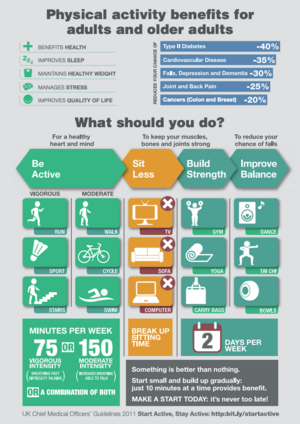
The new WHO 2020 Guidelines stress that any amount of physical activity is better than none, even when the recommended thresholds are not met (this is a very positive message for much of the population who currently fall well short of the desirable minimum).
Key recommendations
Young people aged 5-17 years: Children and adolescents should do at least an average of 60 min/day of moderate-to-vigorous intensity, mostly aerobic, physical activity, across the week. Vigorous intensity aerobic activities (e.g. running), as well as activities that strengthen muscle and bone (e.g. jumping, lifting weights), should be incorporated at least 3 days a week. Children and adolescents should limit the amount of time spent being sedentary, particularly the amount of recreational screen time such as social media and video gaming.
Adults and older adults, including people living with chronic conditions and disabilities: For substantial health benefits, adults should engage in 150-300 minutes of moderate-intensity aerobic physical activity (e.g. brisk walking), or 75-150 minutes of vigorous activity (e.g. running) throughout the week, or equivalent combinations of both where 1 minute of vigorous activity is roughly equivalent to 2 minutes of moderate activity. Examples of aerobic activities include brisk walking, stair climbing, cycling, swimming, or running.
Provided that there are no contraindications resulting from certain severe chronic conditions, additional health benefits can be gained by taking part in more activity than the recommended amounts of 300 min, or 150 min of vigorous-intensity aerobic physical activity per week, or an equivalent combination of moderate-intensity and vigorous-intensity activity throughout the week.
In addition to aerobic physical activity, adults should also do muscle strengthening activities that involve large muscle groups on at least two days per week. Such activities may involve lifting weights or own bodyweight exercises (e.g. push ups, chin ups, sit ups) and can be done at home, in the gym, or in the community, such as public green spaces.
Older adults, defined as those aged 65 years and older, are also encouraged to engage in “multicomponent” on three or more days a week. Examples of multicomponent activities include dancing, which improves aerobic capacity and balance; or standing on one foot while doing bicep curls to concurrently improve balance and upper body muscle strength.
Adults should limit sedentary time and try to replace it with movement of any intensity (including slow walking or moving about). People who, for whatever reason, spend long periods of time being sedentary (e.g. long commuting hours, work-imposed sitting) can help counter some of the harmful effects of too much sitting by exceeding the upper thresholds of the recommended amounts of >300 min, or >150 min of vigorous-intensity aerobic physical activity.
Physical activity during pregnancy and after giving birth: The antiquated belief that “pregnant women should rest” no longer stands. In the absence of specific medical contraindications, regular physical activity throughout pregnancy can improve health outcomes for the mother and the baby.
During pregnancy and in the period after birth, women should aim for at least 150 minutes of moderate intensity physical activity per week, including a variety of aerobic, muscle-strengthening, and stretching activities. Women who regularly did vigorous-intensity activities before pregnancy can maintain these activities safely during and after their pregnancy.[9]
Important: Any physical activity is better than none!!!
A study conducted in 2020 found a significant reduction in the likelihood of developing severe COVID-19 among infected patients who had consistently met the recommended physical activity guidelines in the preceding couple of years. Furthermore, COVID-19 patients who had engaged in less physical activity than recommended had lesser risks of developing severe disease outcomes or dying, than COVID-19 patients who were consistently inactive.[10]
During the COVID-19 pandemic, being physically active will be a challenge for all of us but it is critical that we find and plan ways to be active and reduce our sedentary time. Although our movement around our neighbourhood, town, city, country and the world might be restricted, it remains critical that we all move more and sit less.
The Importance of Physical Activity during the COVID-19 Pandemic
In light of the current situation worldwide, certain benefits of physical activity may be specifically pertinent to the COVID-19 Pandemic. These benefits are[11]:
Physical activity enhances immune function and reduces inflammation therefore it could reduce the severity of infections.
Physical activity is a great stress management tool by reducing symptoms of anxiety and depression.
Physical activity helps bring cortisol levels in balance. Stress and distress (such as during a pandemic) creates an imbalance in cortisol levels and this negatively influences immune function and inflammation.
As already iterated, we are living in unprecedented times and we are learning as we go about the effects and impact of this pandemic. With regards to physical activity and periods of lockdown or restricted and regulated movement, there is some evidence emerging but it is still in the early stages of this pandemic and we won't fully understand the impact of "lock down" for many months.[12]
Insights from data sets
Anecdotal evidence
Many countries in the world are currently in some or other form of lockdown or restricted movement policy and practicing social distancing. Some countries have stricter measures in place with regards to exercise and only allow people to exercise outside/away from their homes once a day or only allow people to exercise outside/away from their homes within a specific time frame or even not allowing any exercise outside/away from home. These restrictions and constraints are specific to each country and the the extent of the COVID-19 outbreak in that specific country. In the media it is publicised that these various measures of lock down may have a positive effect on people's activity levels, with reports of more people being seen outside running, walking, cycling etc. We should be cautious of thinking that this implies that people are now adapting a more active and healthy lifestyle. Physical activity is accrued over a period of 24 hours in many different ways. Organised or structured sport/exercise is merely a small part of physical activity. Most people accumulate their "active minutes" by doing various other activities such as housework, walking the dog, walking/cycling to and from work, walking between tube/train stations, etc. All these activities are part of people's daily lives and contribute to their physical activity minutes. During periods of lockdown, many of these activities are restricted or not even taking place and it is extremely difficult to build in these levels of activity when people's daily movements are restricted.[12]
Wearable Technology
Garmin data Average Daily Steps[13]Garmin data: Virtual Cycling[14]
Data from wearable technology companies such as Garmin also paints an interesting picture of the type of physical activities people engage in during these times. This data, however, is not really representative or cross sectional, but from people who are using wearable technology such as smartwatches and fitness trackers. Interesting to note is that during the month of March 2020 there was a global reduction in the daily average amount of steps taken which is indicative of people being restricted in their movements. Also in March, virtual cycling increased in countries, such as Italy and Spain with severe lockdown restrictions. In other countries, such as the UK and Sweden where outdoor exercise is allowed, there was a significant increase in outdoor cycling activities compared to the same time in 2019.[15] People are finding ways to still be active even in extreme lockdown situations but this data still does not provide a credible idea of a person's cumulative physical activity levels over a 24 hour period.
Early Research Findings
University College London launched a social study on the psychological and social experience of people in the UK during the Covid-19 pandemic.[16] During the second week of the study the researchers looked into exercise and social behaviours of over 47 000 participants.This is app-based and self-reported data. Early stage findings from this study include[16][17]:
1 out of 4 people say that they have had no exercise or even gentle physical activity in the past 7 days.
85% of study participants reported that they did not engage in any moderate or strenuous exercise at all.
40% of study participants reported that they had not done any gentle exercise such as going for a walk.
Even in younger participants (18 - 30 years) four out of five people report not engaging in any moderate or high intensity activity.
People with diagnosed mental and physical health conditions are doing the least physical activity.
Older people are engaging in more gentle activity, but the least in in exercise at home or moderate to strenuous exercise overall.
People living alone are engaging less in all kinds of physical activity.
People from lower income levels are engaging less in all kinds of physical activity.
These are early findings and these results will most likely change over time and as lockdown measures eases.
From the various data sets, it is clear that people are finding ways to exercise, but that is not a true reflection of their accrued physical activity over a 24 hour period. Many people also engage in no moderate or strenuous physical activity during lockdown measures; the implications of this will only be evident later on.
Implications of Physical Inactivity during COVID-19
Health and Social Care
There are a couple of things to consider when looking at the implications of physical inactivity during COVID-19 on health and social care[12]:
It is impossible to predict the outcomes currently
At best we can try and make educated guesses
There are global variations to consider such as the time frame around going into lockdown and easing of restrictions in countries as well as differences in health and social systems in countries.
First wave: Population of people who experience COVID-19
This population of people who experience COVID-19 and recovery from it will still have ongoing needs. They would have had an enforced period of physical inactivity due to the illness. These people will have specific rehabilitation needs. Currently this is the obvious population of people that receives focus and attentions.[12]
Second wave: People with urgent non-COVID-19 conditions
Although, we are dealing with a pandemic at the moment, people all over the world still need healthcare for their existing mental and physical health conditions. Especially during periods of lockdown, this population will still have ongoing needs in terms of self management of their condition. In a scenario where healthcare services and systems are under stress and resources are limited, it is critical to support people in self-management of their condition. Physical activity (and the benefits thereof) is one important way of supporting this population of people to self-manage their conditions so that they are able to cope effectively with symptoms such as pain, stiffness, fatigue or breathlessness. As physiotherapists we can play a critical role in supporting people to stay active so that they are healthy enough to self-manage their condition during this time.[12]
Third wave: Impact of interrupted care on chronic conditions
During periods of lockdown, routine healthcare services have been put on hold or paused in many countries around the world. Services such as routine screenings, diagnostics and elective surgeries have been put on hold. This will have an impact on this population of people as many people who have thought that there would have been progress in the diagnosis or management of their condition. Even after healthcare services resume for this population, it may still take some time for services to clear the backlog caused by periods of lockdown. This may have far-reaching effects. Again, physiotherapists can make a difference with this population by advocating physical activity as a way to self-manage their conditions.[12]
The link between physical activity and mental well-being is clear. Physical activity is a key, critical way to manage mental health well-being and it is important that we as physiotherapists promote this to people, regardless of them having a diagnosed mental health condition. Studies have shown that enforced sedentary behaviour has led to depressive feelings and low moods in healthy people within seven days[19]. Taking into consideration the current situation worldwide with countries in enforced periods of lockdown and isolation, this may potentially have a mammoth impact on the mental well-being of many people and even more so if they do not engage in any form of physical activity!
With decreased physical activity there is the likelihood of musculoskeletal deconditioning.[21] During periods of lockdown where many people's daily activity movements are restricted, musculoskeletal deconditioning is likely to happen in most people. In fit and healthy people this will be less noticeable, but in older people, people with diagnosed health conditions or people who were already functioning very close to the functional threshold, musculoskeletal deconditioning will be more pronounced. This musculoskeletal deconditioning may have a significant impact on these vulnerable populations and may potentially increase the risk of injuries related to falls, such as hip fractures.[22] This will in turn have implications for health and social care services already under stress.
A Call to Action for Physiotherapists
Considering the possible impact of physical inactivity during lockdown, there are ways that physiotherapists can make a significant difference in the lives of their patients:
Clinicians need to be mindful of the impact of lockdown on the mental and physical well -being of people. Now, more than ever the holistic aspects of our assessments need to be emphasised, especially considering the stress on the mental well-being of so many people.[12] People are uncertain, anxious, worried and isolated during lockdown.
Clinicians need to consider the aspects of muscle strength and deconditioning when assessing their patients.[12] Although this is "usually" considered in assessments, it might need to be prioritised and physiotherapists need to find ways to support their clients to:
regain muscle strength
regain joint range
optimise well-being
if areas of musculoskeletal deconditioning are not addressed it may affect a person's ageing trajectory and their overall well-being.
During lockdown, physiotherapists can be active and effective as a global workforce through supporting people to stay physically active.[12]
According to the retrospective observational study[23],
People who are consistently inactive are 2.26 times more likely to be admitted to hospital, 1.73 times more likely to be admitted to ICU and have a 2.49 times greater odds of death.
Other than age, pregnancy and history of organ transplant, being consistently inactive conferred the highest odds for hospitalisation with COVID-19.
Participating in any amount of physical activity has beneficial effects on poor outcomes.
Advice in all clinical interactions during the pandemic should include regular physical activity. This is inline with MECC principles. Physiotherapists should promote physical activity during their clinical contact with patients.
Ways Physiotherapists can Promote Physical Activity during Lockdown
Encourage people to break their periods of inactivity
Encourage people to engage in aerobic activity on a daily basis - even very short periods of exercise have been reported to have real health benefits[24]
Encourage people to engage in strength and balance exercises two to three times a week
Focus on major functional muscle groups
Think about and find ways for people to incorporate these exercises every week during lockdown and beyond
By doing this there is the potential to change physical activity behaviour in the long term
Physiotherapists need to focus on effective messaging during lockdown. This may include positive messages about the benefits of physical activity aligned with the concerns that people have during lockdown and pandemic.[12] These may be:
Physical activity during lockdown may improve mental health
Physical activity during lockdown may help in improving sleep patterns.
Physical activity during lockdown helps you stay healthy.
Physical activity during lockdown helps reduce the demand on health systems.
Ways to Stay Physically Active during COVID-19
Staying physically active during self-isolation[25]
How to Stay Safe while Exercising during COVID-19
Do not exercise if you have a fever, cough or difficulty breathing (symptoms of COVID-19).[26]
Practise social distancing when exercising outdoors and practice good hand hygiene before and after.[26]
If you are not used to physical activity, start slowly with low intensity activities such as walking or low impact exercises for shorter periods of time and gradually build up over time.[26]
Choose the right activity to reduce the risk of injury; the intensity of the exercise should match your fitness levels and health status.[26]
↑Nieman DC, Henson DA, Austin MD, et al. Upper respiratory tract infection is reduced in physically fit and active adults. British Journal of Sports Medicine 2011;45:987-992.
↑Mcleod JC, Stokes T and Phillips SM (2019) Resistance Exercise Training as a Primary Countermeasure to Age-Related Chronic Disease. Front. Physiol. 10:645. doi: 10.3389/fphys.2019.00645
↑Lee IM, Shiroma EJ, Lobelo F, Puska P, Blair SN, Katzmarzyk PT, Lancet Physical Activity Series Working Group. Effect of physical inactivity on major non-communicable diseases worldwide: an analysis of burden of disease and life expectancy. The Lancet. 2012 Jul 21;380(9838):219-29.
↑Sallis R, Young DR, Tartof SY, Sallis JF, Sall J, Li Q, Smith GN, Cohen DA. Physical inactivity is associated with a higher risk for severe COVID-19 outcomes: a study in 48 440 adult patients. Br J Sports Med. 2021 Apr 13:bjsports-2021-104080. doi: 10.1136/bjsports-2021-104080. Epub ahead of print. PMID: 33849909; PMCID: PMC8050880.
↑ 11.011.1Sallis, JF. Physical activity + COVID-19. Lecture to UC San Diego medical students. March 2020. Published on 1 April 2020. Available from https://www.youtube.com/watch?v=F4mcbi9tD-M. [last accessed 10 April 2020]
↑Kramer A, Gollhofer A, Armbrecht G, Felsenberg D, Gruber M. How to prevent the detrimental effects of two months of bed-rest on muscle, bone and cardiovascular system: an RCT. Scientific reports. 2017 Oct 13;7(1):1-0.
↑World Health Organisation.Q&A on physical activity at home during COVID-19. Published on 16 April 2020. Available from https://www.youtube.com/watch?v=xeN-BRRAi2k. (last accessed 9 May 2020)